
Encoders 320+ kbit/s
 Navigation
in alphabetical order
AAC [email protected] (Winamp 5.2) - MPEG-2 AAC Low Complexity CBR, 320.4 kbit/s FBR
CODER: LC-AAC Encoder v1.2 from Winamp 5.2 build 449 Beta
- CD Ripping
- Bitrate: 320kbps
- Channel Mode: Independent Stereo
- Bitstream Options: MPEG-4
- 44100 Hz
DECODER: Winamp 5.2 build 449 Beta
- Disk Writer plug-in v2.1
AAC+ [email protected] (Winamp 5.2) - MPEG-2 AAC High Efficiency CBR , 320.2 kbit/s FBR
CODER: aacPlus (HE-AAC) High Bitrate Encoder v1.2 from Winamp 5.2 build 449 Beta
- CD Ripping
- Bitrate: 320kbps
- Channel Mode: Independent Stereo
- Bitstream Options: MPEG-4
- 88200 Hz
DECODER: Winamp 5.2 build 449 Beta
- Disk Writer plug-in v2.1
- Convert to format: PCM 44100Hz; 16bit; Stereo
aptX [email protected] (Bluetooth) - Codec for Bluetooth A2DP profile, CBR, 352.8 kbit/s FBR
CODER: ffmpeg 4.0.2 (Lavc58.18.100 aptx)
- usage: ffmpeg -i ref.wav -acodec aptx out.aptx
- 44100 Hz, 16bit
DECODER: ffmpeg 4.0.2 (Lavc58.18.100 pcm_s16le)
- usage: ffmpeg -sample_rate 44100 -i out.aptx out.wav
aptX HD [email protected] (Bluetooth) - Codec for Bluetooth A2DP profile, CBR, 529.2 kbit/s FBR
CODER: ffmpeg 4.0.2 (Lavc58.18.100 aptx_hd)
- usage: ffmpeg -i ref.wav -acodec aptx_hd out.aptxhd
- 44100 Hz, 16bit
DECODER: ffmpeg 4.0.2 (Lavc58.18.100 pcm_s16le)
- usage: ffmpeg -sample_rate 44100 -i out.aptxhd out.wav
ATRAC SP CBR@292 (MD) - ATRAC1 SP (Type-R) 292 kbit/s (Minidisk)
ENCODER: h/w DSP (Type-R)
- digital recording
DECODER: h/w DSP (Type-R)
- digital playback
- time warping
ATRAC3plus [email protected] - ATRAC3plus 352 kbps (353.0 kbit/s FBR)
ENCODER: SonicStage 4.3.01.14050
- Import a CD
- Format: ATRAC
- Recording Quality: High
- Bit rate: 352 kbps
- 44100 Hz Stereo
DECODER: SonicStage 4.3.01.14050
- Save in WAV Format
mp3 [email protected] (Lame 3.90.3) - MPEG-1 Layer 3 CBR, 320.2 kbit/s FBR
CODER: Lame 3.90.3
- usage: lame -b320 -h ref.wav out.mp3
- 44100 Hz Stereo
DECODER: MAD 0.15.2b
mp3 [email protected] (Lame 3.97b2) - MPEG-1 Layer 3 CBR, 320.2 kbit/s FBR
CODER: Lame 3.97b2
- usage: lame --preset insane ref.wav out.mp3
- 44100 Hz Joint Stereo
DECODER: MAD 0.15.2b
Opus [email protected] (libopus 1.1) - free audio format (IETF RFC6716), VBR, 290.1 kbit/s FBR
CODER: opusenc from opus-tools 0.1.9
- 44.1/16 -> 48/24 by Audition CS6
- usage: opusenc --bitrate 256 ref48.wav out.opus
- 48000Hz Stereo
DECODER: foobar2000 v1.3.7 (32bit output)
- 48/32 -> 44.1/32 by Audition CS6
SBC [email protected] (High Quality) - Subband codec for Bluetooth A2DP profile, CBR, 328.0 kbit/s FBR
CODER: SBC Encoder LIB Version 1.5 (Philips)
- usage: sbc_encoder -jv -r328000 -oout.sbc ref.wav
- High Quality setting recommended by Bluetooth SIG
- 44100 Hz Joint Stereo
- bitpool:53, bands:8, allocationn method: SNR
DECODER: SBC Decoder LIB Version 1.5 (Philips)
SBC [email protected] (Max. bitrate) - Subband codec for Bluetooth A2DP profile, CBR, 372.1 kbit/s FBR
CODER: SBC Encoder LIB Version 1.5 (Philips)
- usage: sbc_encoder -jv -oout.sbc ref.wav
- max. possible bitrate for SBC codec
- 44100 Hz Joint Stereo
- bitpool:61, bands:8, allocationn method: SNR
DECODER: SBC Decoder LIB Version 1.5 (Philips)
SBC XQ [email protected] (Bluetooth) - Subband codec for Bluetooth A2DP profile, CBR, 452.0 kbit/s FBR
CODER: SBC Encoder LIB Version 1.5 (Philips)
- usage: sbc_encoder -v -p -r453000 -oout.sbc ref.wav
- SBC XQ default setting for BT EDR2
- 44100 Hz, Dual Channel - bitpool: 38, bands: 8, blk_len: 16, allocation method: Loudness
DECODER: SBC Decoder LIB Version 1.5 (Philips)
SBC XQ [email protected] (Bluetooth) - Subband codec for Bluetooth A2DP profile, CBR, 551.2 kbit/s FBR
CODER: SBC Encoder LIB Version 1.5 (Philips)
- usage: sbc_encoder -v -p -r552000 -oout.sbc ref.wav
- SBC XQ default setting for BT EDR3
- 44100 Hz, Dual Channel - bitpool: 47, bands: 8, blk_len: 16, allocation method: Loudness
DECODER: SBC Decoder LIB Version 1.5 (Philips)
Vorbis [email protected] (Xiph 1.3.1) - Ogg Vorbis, 313.4 kbit/s FBR
CODER: OggEnc v2.87 (libVorbis 1.3.1)
- usage: oggenc2 -q9 ref.wav
- 44100 Hz Stereo
DECODER: OggDec v1.9.7 (libVorbis 1.3.1)
wma 9.1 [email protected] - Windows Media Audio 9.1 (Standard) CBR, 322.8 kbit/s FBR
ENCODER: MS Windows Media Encoder 9.00.00.2980
- Mode: CBR
- Audio format: 320kbps, 44 kHz, stereo CBR
DECODER: MS Windows Media Encoder 9.00.00.2980
The ratings above are live. Each time a participant of SE listening test sends a grade - the corresponding rating updates immediately. You can participate as well, it's easy and looks like fun, no need for "golden ears" or special equipment. Just visit our Testing Room, download a random sample, listen it in headphones and send back your grade. Afterwards corresponding rating will get new value and become more accurate. As the testing is fully blind you'll get to know the device/technology you've tested after sending your grade only. Thanks.
You can add a codec/setting to SE listening tests for $50 donation. Please, make your request ►
How to read the ratings
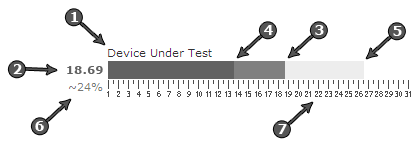
The rating bar consists of the following elements:
 - Device or technology being tested.
 - Value of actual perceived audio quality (rating) which is also indicated
by the bar length  . Anchor points could be interpreted as follows:
In most cases using this device/technology:
1.0 – you will hear heavily distorted sound
2.0 – you will hear unpleasant sound artifacts
3.0 – you will hear distinctly audible but tolerable sound artifacts
4.0 – you will hear faintly discernible sound artifacts
5.0 – you will not hear any sound artifacts
above 5.0 – all sound artifacts will be beyond threshold of human perception with corresponding perception margin
 and
and  - "low" and "high" of rating. As each device is tested with nine different sound samples, there are nine different local ratings for a device. In fact, the actual rating is an average of those nine local ratings. The highest and the lowest ones are indicated. Big gap between them means that sound quality of device/technology is not consistent enough. It varies with type of sound material: music of different genres and complexity, voice with or without music, noisy/clear recordings etc. The lowest local rating is more important in this sense as it indicates worst case behavior of tested device.
 - Accuracy of rating. It is also indicated by the color of bar - more accurate ratings have darker bars and less percentage values. Accuracy depends on number of grades returned by participants. In most cases 5% or less is OK.
 - Ruler for convenient estimation of "highs" and "lows".
For devices with small impairments (not audible in ordinary listening tests) SoundExpert amplifies their sound artifacts to some predefined extent. Ratings of such devices are calculated analytically taking into account both the grades received and the amplification applied. They are above 5th grade on the scale showing certain quality headroom of such devices.